Free shipping in NL, BE and DE – worldwide delivery

Green dreams: discover the power of houseplants in your bedroom
Why a few well-chosen plants in the bedroom genuinely improve sleep — and which ones deliver the biggest benefit.
The old idea that plants in the bedroom use up oxygen and ruin your sleep is myth. The reality is the opposite: a few well-chosen houseplants improve air quality, reduce stress, and make a bedroom feel like a sanctuary. Not all plants are equal, though, and a few are genuinely better than others for the bedroom specifically. Here's what the research actually says, and which plants are worth a place by your bed.
- Cleaner, fresher air
- A calmer atmosphere
- The sleep effect
- The best plants for the bedroom
- Myths worth ignoring
Cleaner, fresher air
Houseplants absorb carbon dioxide and release oxygen during the day. Some species also continue oxygen production at night, and many filter common indoor air pollutants — formaldehyde, benzene, trichloroethylene — that come from carpets, paints, and synthetic fabrics. The famous NASA Clean Air Study from 1989 showed measurable air quality improvements with as few as two plants per modest-sized room.
The effect isn't massive in a single bedroom (you'd need a small forest to fully purify a typical room), but it's real and additive to good ventilation.
A calmer atmosphere
This is where plants pull their real weight. Studies on indoor environments consistently find that the presence of greenery reduces measured stress markers — cortisol levels, blood pressure, self-reported anxiety. A bedroom with one or two plants reads as a natural space, which signals safety to the nervous system. The effect is bigger than people expect.
The sleep effect
Several plants release oxygen at night (most release it during the day). Some plants — like Mother-in-Law's Tongue (Sansevieria) — also help regulate humidity, which matters because dry winter air disrupts sleep more than people realise. Combined with the calming effect, plants can quietly support better sleep without you doing anything actively.
The best plants for the bedroom
- Mother-in-Law's Tongue (Sansevieria) — releases oxygen at night, almost impossible to kill, perfect for forgetful waterers
- Lavender — the scent is mildly sleep-promoting in research; needs a bright spot near a window
- Areca Palm — large, sculptural, regulates humidity well
- Ficus Lyrata, Philodendron, Scindapsus — leaves absorb sound waves slightly, useful in noisy areas
- Spider Plant — easy to care for, removes formaldehyde and xylene from the air
- Aloe Vera — releases oxygen at night, also useful for skin (the gel)
- Strelitzia (Bird of Paradise) — large, dramatic, surprisingly easy
Two plants is the sweet spot. More than four can start to feel cluttered.
Myths worth ignoring
- Plants steal your oxygen. No — the carbon dioxide they release at night is negligible compared to a sleeping person breathing.
- Plants attract mosquitoes. Standing water in saucers attracts mosquitoes. The plants themselves don't.
- You need expensive air-purifying plants. The basic recommendations above work fine.
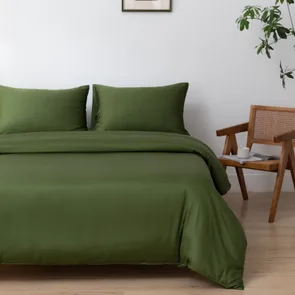
Combine your plants with bamboo bedding and a Sage Green colour palette and the bedroom takes on a quiet garden quality — calming, fresh, and slightly more interesting than any minimal interior. For bedroom styling that complements plants, see 5 bedroom styles that match Sage Green.
OUR CATEGORIES



ANOTHER TALE BEFORE BEDTIME